



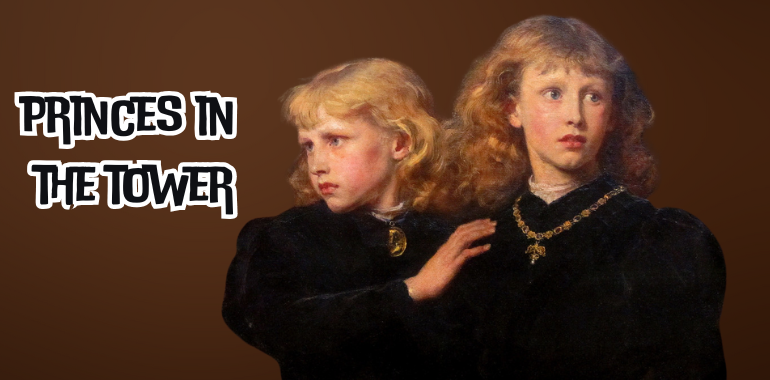
One of the most compelling and enduring mysteries in English history revolves around the fate of the Princes in the Tower. This enigmatic tale involves Edward V and his younger brother, Richard of Shrewsbury, Duke of York, who were lodged in the Tower of London in the late 15th century and subsequently vanished without a trace. Their disappearance has fueled centuries of speculation, conspiracy theories, and intense historical debate.
Who Were the Princes in the Tower?
The Princes in the Tower were Edward V, the elder prince, and his brother Richard, Duke of York. Edward V was born in 1470 and became King of England at the young age of 12 after the death of his father, King Edward IV. His brother Richard was born in 1473. In 1483, following the sudden death of Edward IV, Edward V’s reign lasted only a few months before he and his brother were placed in the Tower of London.
At the time, the Tower was not just a fortress but also a royal residence, commonly used to house and protect members of the royal family. The princes were lodged there supposedly for their safety, but their fate soon became a cause for grave concern.
Historical Context: The Wars of the Roses
To understand the mysterious fate of the Princes in the Tower, it is important to consider the turbulent historical backdrop — the Wars of the Roses. This series of civil wars between the rival houses of Lancaster and York severely destabilized the English monarchy in the 15th century.
Edward IV came from the House of York and managed to secure his throne after years of conflict. However, his death in April 1483 created a fragile power vacuum, with many factions vying for influence. Edward V’s uncle, Richard, Duke of Gloucester (later King Richard III), was named Protector of the Realm during Edward’s minority, placing him in a position of enormous power.
The Princes’ Imprisonment and Disappearance
Following Edward IV’s death, Edward V and Richard of Shrewsbury were taken to the Tower, ostensibly in preparation for Edward’s coronation. However, that event never occurred. Just weeks later, Richard, Duke of Gloucester, declared the princes illegitimate based on his brother’s alleged secret pre-contract of marriage, thereby disqualifying Edward V’s claim to the throne.
Richard assumed the throne as King Richard III. Meanwhile, the princes were confined in the Tower and soon ceased to be seen in public. Their ultimate fate remains one of the darkest and most debated mysteries of English history.
Theories About the Fate of the Princes in the Tower
Over the centuries, historians and writers have proposed numerous theories about what happened to the Princes in the Tower. The most widely accepted ideas include:
1. Murder by Richard III
The dominant theory is that King Richard III ordered the murder of his nephews to secure his claim to the throne. This belief is supported by the fact that the princes vanished shortly after Richard became king, combined with contemporary rumors and subsequent Tudor propaganda portraying Richard as a villain.
However, there is no conclusive evidence proving Richard’s guilt, and many historians argue the charges against him were exaggerated or fabricated after his death to legitimize the reign of Henry Tudor (Henry VII).
2. Murder by Henry Tudor Supporters
Another theory posits that Henry Tudor’s supporters, eager to solidify Henry VII’s position as king, might have eliminated the princes later to remove any rival claims. Since Henry defeated Richard III at the Battle of Bosworth Field in 1485 and married Elizabeth of York, this theory has some plausibility, though it lacks definitive proof.
3. The Princes Were Secretly Removed or Escaped
There have been speculative accounts suggesting that one or both of the princes may have been secretly removed from the Tower and survived captivity, perhaps growing up in hiding. Some believe one of the young Richard’s descendants later appeared as Perkin Warbeck, a famous pretender to the throne during Henry VII’s reign.
4. Death by Natural Causes or Accident
A less sensational but plausible explanation is that the princes died of illness while imprisoned. Conditions in the Tower were not necessarily safe or healthy, and the sudden disappearance could be attributed to natural causes.
Discovery of Remains and Modern Investigations
In 1674, during repair work at the Tower of London, a small box containing two small human skeletons was found beneath a staircase. These bones were assumed to be those of the Princes in the Tower and were later re-interred in Westminster Abbey’s Henry VII Chapel.
Modern forensic analysis has been limited, as the remains were reburied without extensive examination. Some experts questioned whether the bones were actually those of the princes. More recently, historians and archaeologists have called for further scientific testing, including DNA analysis, but such inquiries have faced obstacles from preservation authorities.
The Princes in Popular Culture
The story of the Princes in the Tower has captivated the public imagination for centuries and has been depicted in numerous works of literature, drama, and film. William Shakespeare immortalized the tale in his play Richard III, where Richard is portrayed as a ruthless murderer.
Books, documentaries, and historical novels continue to explore the mystery, often reflecting contemporary means of interpreting eyewitness accounts and newly discovered evidence. The intrigue surrounding the princes underscores the dangers of dynastic politics and the murky realities of medieval power struggles.
Why the Princes in the Tower Mystery Endures
The tale of the Princes in the Tower resonates because it combines royal intrigue, political ambition, and unanswered questions. It highlights the vulnerable position of child monarchs and the brutal nature of succession disputes in medieval England. The uncertainty surrounding their fate invites ongoing debate and keeps the story alive in historical discourse.
Despite centuries of research, the exact circumstances of their disappearance remain elusive, making the story a unique intersection of history, mystery, and myth.
Conclusion
The Princes in the Tower represent one of the most perplexing and tragic episodes of English history. The disappearance of Edward V and Richard of Shrewsbury continues to spark intrigue and debate among historians, enthusiasts, and the general public. Whether victims of political murder or casualties of unfortunate circumstances, the princes’ story serves as a powerful reminder of the complexities of power, family, and legitimacy in the medieval period.
As new historical methods and technologies develop, there remains hope that one day the true fate of the Princes in the Tower may finally be uncovered.
Want to know about “Jynxzi Net Worth: An In-Depth Look at Her Earnings and Career Growth” Check out our “Entertainment” category.


